At Rula, our mission is to deliver care that is personal, responsive, and aligned with each client's goals.
Measurement-Informed Care (MIC) is a powerful way to help us achieve this by providing real-time insights that allow therapists to individualize treatment, track progress, and strengthen outcomes. Measurement-informed care is a standard of care that reflects the belief that clients deserve therapy that adjusts with them, supporting them toward their goals.
This article reviews what measurement-informed care is, how it benefits your clinical work, and how to incorporate it meaningfully into sessions.
What Is Measurement-Informed Care (MIC)?
At Rula, measurement-informed care involves brief, research-based, empirically-validated questionnaires completed by clients at regular intervals throughout treatment. These tools gather information on domains critical to therapy outcomes, such as mood, safety, stress levels, and the therapeutic alliance. Ultimately, they are clinical instruments designed to enhance shared decision-making and personalize care, which are central to a high-quality therapy experience.
Measurement-Informed Care acts like a GPS for the therapy journey.
It provides regular checkpoints, helping both you and your client understand where they are, where they’ve been, and where they might want to adjust course.
Research consistently shows that Measurement-Informed Care improves client outcomes, decreases attrition rates, and increases overall client satisfaction (Lambert et al., 2001; Bickman et al., 2011). Clients benefit from measurement-informed care as it provides an objective avenue to provide direct feedback about their symptoms and experiences in treatment, strengthening the therapeutic alliance and keeping their voice at the center of care.
This collaborative approach is why measurement-informed care is gaining widespread support in behavioral health: both the American Psychological Association and the American Psychiatric Association endorse measurement-informed care for its ability to improve client outcomes.
How do I use Measurement-Informed Care in My Practice?
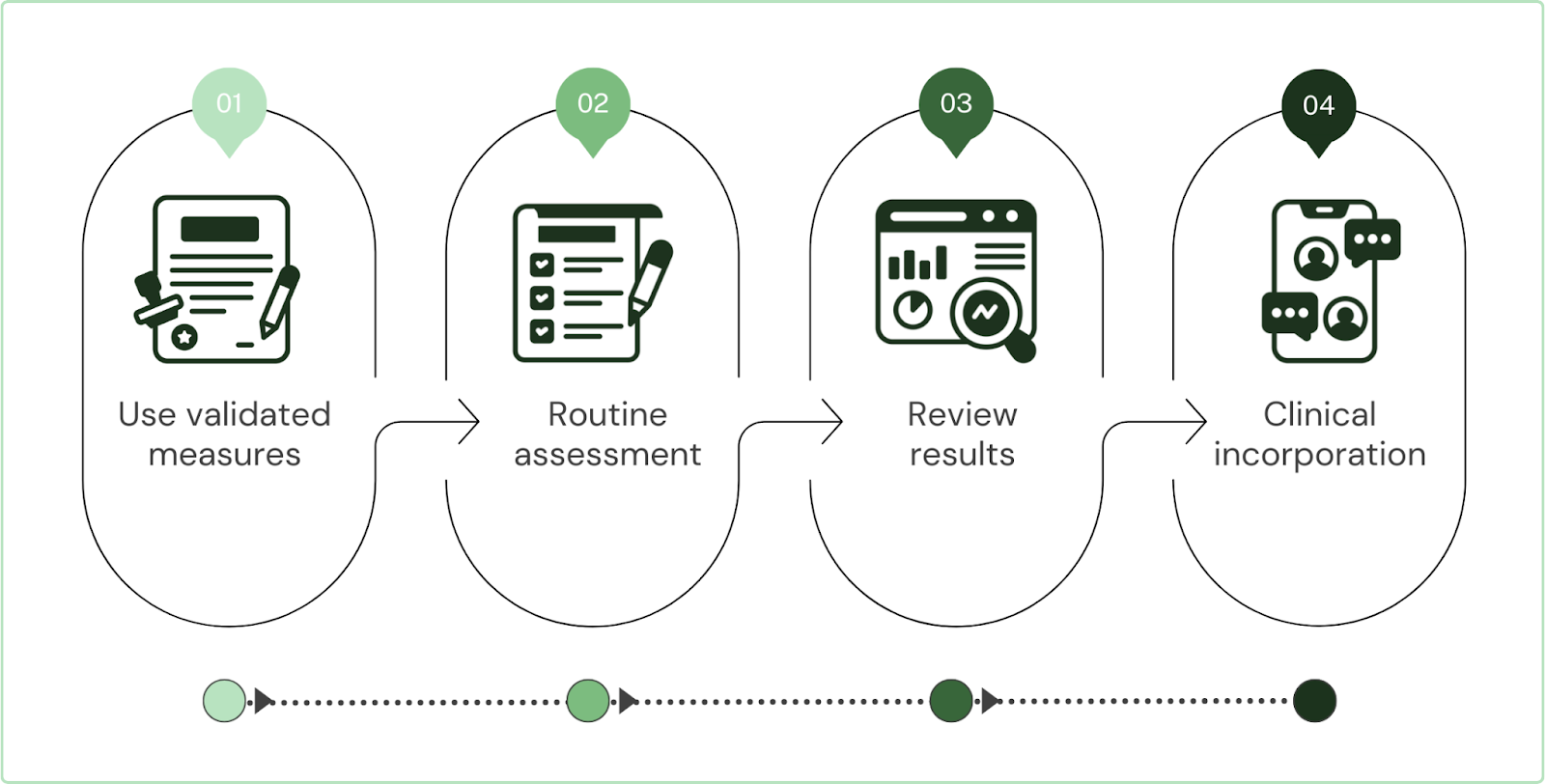
Use validated measures
Rula offers brief, self-reported assessments for children and adult clients. These measures track both symptom severity and the therapeutic alliance, taking only minutes to complete. Below we will break down the assessments given.
For patients ages 5-10
- PROMIS Depression Parent Proxy: Measures developed to assess caregiver-reported symptoms of depression. Patients ages 5-7 will receive this assessment in which their parent or guardian will complete as proxy.
- PROMIS Anxiety Parent Proxy: Measures developed to assess caregiver-reported symptoms of anxiety. Patients ages 5-7 will receive this assessment in which their parent or guardian will complete as proxy.
- PROMIS Depression (pediatric): Validated self-report tool developed to assess depressive symptoms in youth. Patients ages 8-10 will receive this assessment.
- PROMIS Anxiety (pediatric): Validated self-report tool developed to assess anxiety symptoms in youth. Patients ages 8-10 will receive this assessment.
- Child C-SSRS Screener: Columbia Suicide Severity Rating Scale for suicidal ideation, plan, and intent.
- Therapeutic Alliance questions
For patients ages 11+
- GAD-7: Generalized Anxiety Disorder - 7 for anxiety
- PHQ-9 or PHQ-A (modified for adolescents): Patient Health Questionnaire - 9 for depression
- C-SSRS Screener: Columbia Suicide Severity Rating Scale for suicidal ideation, plan, and intent
- CAGE-AID: Drug and alcohol use screener (one-time baseline measure for new clients)
- Therapeutic Alliance questions
| Rula is expanding our toolkit! We have future plans to provide a wider range of measurement-informed care tools through a measurement library. This library will include a wide array of clinical measurement tools across diagnoses and populations, allowing you to personalize care even further. |
Routine assessment
Rula automatically collects the data for you! 48 hours before every scheduled appointment, clients whose age aligns with the relevant measures are automatically emailed a link to complete the measurement surveys.
For client safety, Rula automatically flags potential risks. If a client answers affirmatively to thoughts of suicide or self-harm on the PHQ-9 (Question #9), PROMIS Depression measures, or any item on the C-SSRS Screener, they'll see a real-time pop-up with the following information:
“We are glad you are in care with us. Based on your survey responses, we’ve noticed you might need some additional support or resources. If you are experiencing a mental health crisis, please call or text 988 to be connected with the 24-hour Suicide and Crisis Helpline. If this is a life-threatening emergency, please call 911 or go to your nearest emergency room. Additional resources that might be helpful at this time can be found HERE.”
Please note, however, that this does not take the place of your clinical risk assessment, safety planning, and related interventions when you meet with the client to support their safety.
Review results
Once your client completes the measurement survey link, the “Measures” section of the client chart in the Rula provider portal will display any measurement surveys that the client has submitted. Please check out this article for more information on how to locate these results in the portal.
After reviewing the results with the client, be sure to document your review of the results and how you used this data to support your client’s care. Reviewing your clients’ completed measures is essential as a part of holistic clinical care, as well as preventing liability concerns for the therapist.
| Note: Before their appointment, you can verify if your client has finished the measurement survey and send a reminder if needed. Check out the article HERE to learn more. |
Want to learn more about each of the measures that clients receive, including the questions, scoring, and clinical interpretation? Check out these quick guides on:
- PROMIS Depression Parent Proxy
- PROMIS Anxiety Parent Proxy
- PROMIS Depression (pediatric)
- PROMIS Anxiety (pediatric)
- GAD-7
- PHQ-9
- Child C-SSRS Screener
- C-SSRS Screener
- Therapeutic Alliance
|
Note: If a client reports not receiving their survey, they should first check their junk and spam folders for emails mentioning "check-in survey." Our system automatically sends the measurement-informed care surveys to the email the account is registered with. Clients can locate their registered email address in the "Forms" section in their Rula patient portal. If the client is under the age of 18, the email might be sent to a parent/guardian. Please discuss this with your client’s parent/guardian to be sure the minor is able to complete the surveys. |
Clinical incorporation
Turn data into action! Review the results with your client and discuss how they impact care planning. measurement-informed care treatment and monitor clinical progress.
Want to see it in action? Check out the resources below for practical tips and examples of using measurement-informed care in sessions and in a variety of clinical contexts.
- Reviewing measurement-informed care in session with clients
- Strategies for increasing completion of measurement-informed care surveys
- Navigating slow client progress on measurement-informed care surveys
- Responding to increases in symptom severity on measurement-informed care surveys
- Responding to ruptures in the therapeutic alliance
- Addressing discrepancies between measurement-informed care survey scores and clinical presentation
- Responding to decreases in scores on measurement-informed care surveys and clinical improvement
How Measurement-Informed Care Enhances the Therapeutic Process
Track Progress Transparently:
Measurement-informed care can reveal meaningful gains that clients might not immediately recognize, helping to reinforce motivation and acknowledge growth.
Personalize Treatment:
Measurement-informed care data offers a real-time reflection of the client’s experience, allowing you to tailor interventions, goals, and session focus dynamically.
Empower Clients:
By reviewing Measurement-informed care results collaboratively, clients become more engaged partners in their care, promoting autonomy and strengthening therapeutic rapport.
Identify Challenges Early:
Subtle deteriorations or emerging concerns can be flagged before they escalate, allowing for earlier intervention and improved clinical outcomes.
How to Integrate Measurement-Informed Care Into Your Sessions
Measurement-Informed Care is most powerful when it is actively integrated into clinical conversations. We have a robust article that discusses strategies for incorporation in further detail, but here are some quick tips and tricks:
-
Check-Ins: Start sessions by reviewing recent measurement-informed care data. Ask clients how it matches their own sense of progress.
-
Addressing Risk: If measurement-informed care scores indicate safety concerns (e.g., via C-SSRS), prioritize these at the session’s start to ensure timely response.
-
Spotting Patterns: Use measurement-informed care trends to identify changes- like mood shifts or alliance issues- that might not emerge through conversation alone.
-
Adjusting Treatment: When progress stalls or declines, use measurement-informed care to guide discussions around revising goals or exploring new interventions.
- Celebrating Wins: Highlight even small gains in measurement-informed care to reinforce client effort and motivation.
Measurement-informed care is intended to deepen collaboration, not add burden. Think of it as another tool in your clinical toolbox- one that helps illuminate the path when the way forward isn’t immediately clear.
Addressing Client Concerns About Measurement-Informed Care
Some clients may have questions or hesitations. It's helpful to normalize measurement-informed care as part of high-quality, responsive care. You can emphasize:
- Most insurances do not use measurement-informed care scores to determine coverage or ongoing access to care, but please note that this is changing. For example, Kaiser Hawaii uses measurement-informed care to help determine if further sessions will be authorized.
- It is up to the clinician to determine ongoing symptoms and functional impairment to determine medical necessity, and measurement-informed care is one tool of many to provide data that supports the ongoing medical necessity of care.
- It is up to the clinician to determine ongoing symptoms and functional impairment to determine medical necessity, and measurement-informed care is one tool of many to provide data that supports the ongoing medical necessity of care.
-
Please note that the measurement-informed care cadence for Kaiser patients is changing, rolling out in phases between June and July 2026. Kaiser patients will be prompted to complete certain measures (Quality of Life (QoL), Therapeutic Alliance (TA), C-SSRS / Child C-SSRS (Kaiser SoCal ONLY), PHQ/GAD/PROMIS Depression/PROMIS Anxiety (Kaiser NCAL ONLY)) before each visit or once a week, depending on the patients coverage (unless they have already completed one within the last 3 days). Following these rules is a contractual requirement that protects the patient's insurance coverage and enables consistent tracking of their clinical progress.
- Measures responses are protected under HIPAA, just like all clinical records.
- Measurement-informed care is a tool for tailoring therapy, not for judging clients or policing outcomes.
We encourage therapists to use measurement-informed care as a tool to advocate for clients, supporting their voice and goals throughout their therapeutic journey.
Measurement-Informed Care Supports Clinical Excellence
At Rula, we view Measurement-Informed Care as a key element of high-quality therapy.
It centers the client's experience, empowers clinicians with actionable data, and strengthens the therapeutic alliance.
Just like a GPS that recalibrates during a trip, measurement-informed care ensures therapy remains flexible, informed, and truly guided by where the client wants to go.
If you have any questions about measurement-informed care integration or if you’d like additional resources or support, our Clinical Quality team is here to help.
Updated